Programs | May 30, 2025
Working at NYRP Since 1996
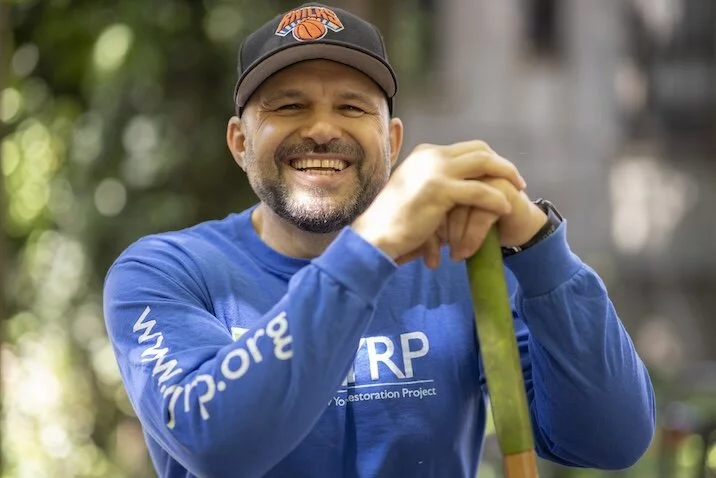 Almost thirty years after joining NYRP, Jason Sheets's peers agree that there’s hardly a corner of New York City where he hasn't made a positive impact.
 New York Restoration Project’s work was just getting started in 1996 when Jason Sheets joined as an AmeriCorps volunteer. He has had boots on the ground ever since, helping lead the organization’s milestone achievements including preserving more than 50 community gardens; executing the MillionTreesNYC initiative; and establishing our Gardens for the City program that’s built and renovated more than 300 urban green spaces.
Almost thirty years after his first day, Jason’s peers agree that there’s hardly a corner of New York City where he hasn’t made a positive impact. In addition to building and restoring hundreds of green spaces, Jason has also fostered a network of community gardeners, horticulturists, and civic partners. He is beloved by his colleagues who describe him as “wearing his heart on his sleeve” and “one of a kind in the New York City greening world.” Simply put, NYRP wouldn’t be what it is today without Jason Sheets.
Below, Jason—whose most recent title is Director of Community Garden Operations and Citywide Greening Projects—looks back on his experience of helping NYRP flourish over the past three decades.
The following interview has been edited for brevity and clarity.
How did you originally get involved with New York Restoration Project?
Jason Sheets: I joined the organization as an AmeriCorps volunteer in 1996. I was a student at the New School for Social Research looking to get into land stewardship and forest restoration, so I was very excited to have the opportunity to work in parks and gardens in the city.
I first worked in Northern Manhattan’s Fort Tryon and Fort Washington Parks before transitioning to Highbridge Park on the east side. That area hadn’t been maintained for over 30 years and was overflowing with garbage and wrecked cars. NYRP led its initial and transformative cleanup, meticulously removing debris daily to reveal the earth.
When did you make the move from working in NYRP’s Northern Manhattan Parks to our citywide community garden network?
JS: In 2000, NYRP’s Executive Director at the time tasked me with establishing a field operations team to support our fifty-plus newly acquired community gardens. I quickly built a team including AmeriCorps volunteers to help manage these spaces. Not all, but many gardens were like Highbridge Park but on a smaller scale: they were garbage-strewn lots with dilapidated infrastructure. My initial work involved extensive cleanup, horticulture, and tree pruning. I also engaged with community groups to improve safety and accessibility. Over five years, I witnessed these sites evolve from neglected lots into vibrant community hubs.
In more recent years, you’ve helped establish and develop our Gardens for the City program, which has created and restored more than 300 community gardens citywide. How did this deeply impactful program begin?
JS: During the historic MillionTreesNYC initiative, we discovered a strong community need for gardens, not just trees. As people sought our help for transforming underused green spaces, we initially offered planters and advice. The consistent and overwhelming demand eventually led us to formalize this support into the Gardens for the City program, which now provides expert design consultation, garden infrastructure, construction, and plant material for free to our selected community partners. To date, we have completed more than 300 of these garden projects across all five boroughs.
What’s one of your favorite memories at NYRP?
JS: I’d have to say our Gardens for the City build at New Roots Community Farm in 2021. They’re affiliated with the International Rescue Committee (IRC) and offer critical services to refugees, asylees, and immigrant communities in addition to local South Bronx residents. Many of the refugees and asylee clients of the IRC who use this farm come from agricultural backgrounds or places that are less urban than New York City. In this way, this farm is as a place for members to relax and connect with their culture through agriculture.
Compared to our other garden builds, the New Roots one was like a next level in terms of the work plan and the size of project. Over 3 weeks, we engaged over 100 volunteers; built 26 new raised garden beds; installed a 60-foot-by-16-foot tunnel; upgraded an existing greenhouse; and planted 131 new perennials, 50 shrubs, and 9 fruit trees. We also installed a new shade structure and a 3-bin compost system while adding over 60 cubic yards of fresh soil and wood chips. This project significantly advanced New Roots’ vital work in The Bronx, and has been a huge win for urban agriculture in the city.
Over all these years, what makes you proud to work at NYRP?
JS: At NYRP, I’m endlessly proud of our commitment to providing clean, green open spaces in underserved communities. It’s inspiring to see our mission evolve and witness our staff’s ongoing dedication to making the benefits of nature more accessible to all New Yorkers. I’m immensely proud of NYRP’s 30 years of accomplishments in parks and gardens, particularly transforming once-desolate Highbridge Park into a thriving urban forest. Seeing our community gardens across the five boroughs thrive and mean so much to residents fills me with joy; I’m happy to have played a part.