Press Release | October 5, 2026
NYRP Helps Return the American Chestnut Back to the Bronx Zoo After More Than a Century
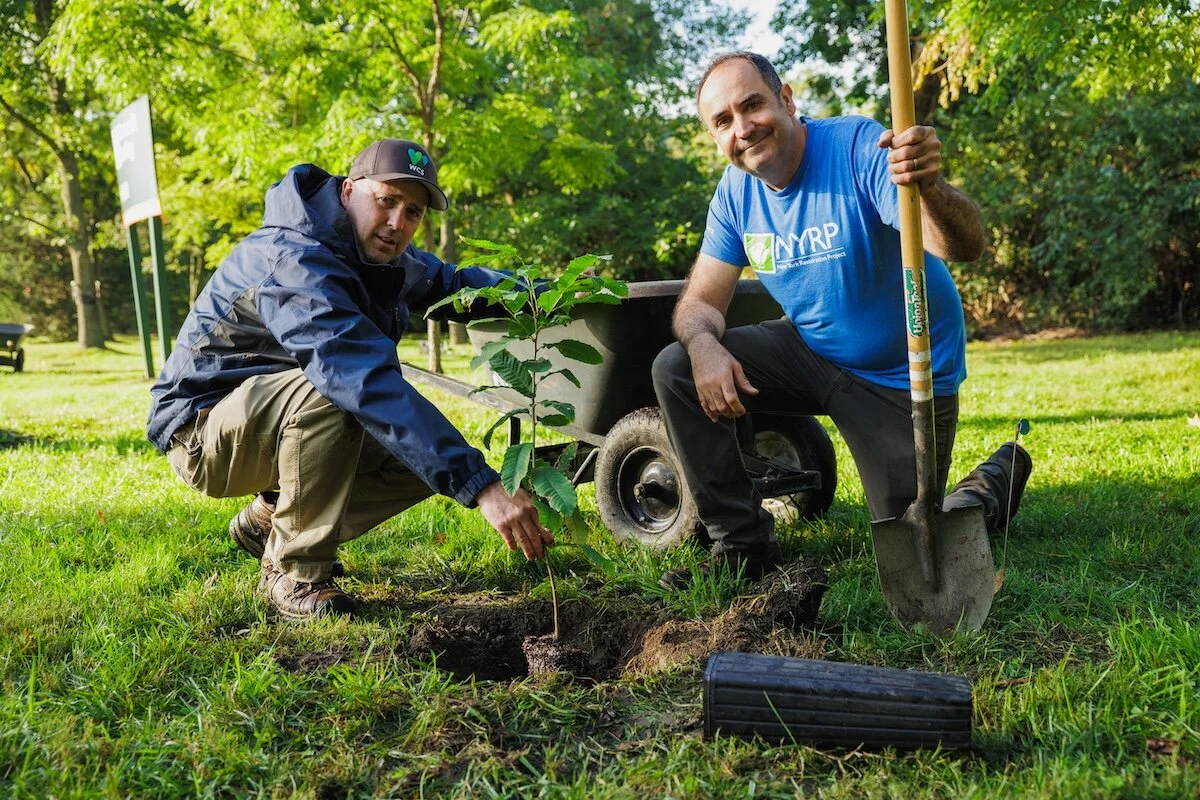 Robert Scheuerman (left), Horticulture Manager at the World Conservation Society's Bronx Zoo, and Jason Smith, Director of Northern Manhattan Parks NYRP. Credit: Paul Frangipane
 New York Restoration Project’s gift of 20 hybrid American chestnut trees marks a symbolic return to the Wildlife Conservation Society’s Bronx Zoo—where chestnut blight was first documented in 1904—more than a century after it devastated an American icon
BRONX, N.Y.—On Monday, October 5, 2026, the Wildlife Conservation Society’s Bronx Zoo welcomed 20 hybrid American chestnut trees, donated by New York Restoration Project in partnership with The American Chestnut Foundation (TACF), marking the first time American chestnut trees have been planted at the zoo since chestnut blight devastated the species and eliminated billions of American chestnut trees across North America.
Under blue fall skies, the horticulture team at the WCS Bronx Zoo and gardeners from New York Restoration Project planted the trees at three locations across the zoo. The two- to three-foot saplings were planted along the east bank of the Bronx River, which runs through the zoo and along the pedestrian path just north of Tiger Mountain.
The return of the American chestnut to the zoo connects the institution’s history with the tree’s ongoing conservation and restoration efforts. In 1904, the zoo’s Chief Forester, Hermann Merkel, was the first to document the devastating chestnut blight, which would go on to decimate nearly 4 billion American chestnut trees across North America.
More than a century later, the planting of these trees at the Wildlife Conservation Society’s Bronx Zoo offers an opportunity to reflect on what was lost to the blight and what is possible through conservation, research, and restoration.
The planting is part of NYRP’s ongoing effort to help return the American chestnut to its native range. NYRP leads the largest urban effort to help restore the American chestnut, working with partners to bring hybrid trees back into New York City’s landscape.
Once one of the most important trees of eastern North America, the American chestnut was widespread from Maine to Florida and west to the Ohio Valley, providing food and habitat for wildlife as well as timber for generations of people. In the early 20th century, chestnut blight arrived in North America and spread rapidly, transforming forests across the species’ native range.
Today, the American chestnut is considered functionally extinct in the wild. Hybrid American chestnuts are being planted as part of ongoing restoration efforts, combining the American chestnut’s genetic heritage with blight resistance to help return this iconic species to the landscapes where it once thrived.
Since 2017, New York Restoration Project has worked with partners including The American Chestnut Foundation and NYC Parks to help bring the American chestnut back to New York City. Through this effort, NYRP planted and now stewards more than 200 hybrid American chestnuts in Northern Manhattan’s Highbridge Park, the largest chestnut grove in New York City.
In 2025, NYRP launched the 1,000 Chestnut Challenge to expand this work by engaging New Yorkers and local institutions in a community science effort to plant and monitor chestnut saplings over time, including TACF hybrids and trees propagated from chestnuts grown in New York City.
The planting at the zoo expands this growing network of chestnut restoration into another major New York City park. Together, NYRP and the Wildlife Conservation Society’s Bronx Zoo are helping rebuild a living population of this iconic tree, connecting New Yorkers to the species’ history while giving future generations the opportunity to see American chestnuts thrive in New York City once again.
“Bringing the American chestnut back to New York City is both an act of restoration and an invitation to imagine what our urban landscape can look like in the future,” said Lynn Bodnar Kelly, Executive Director of New York Restoration Project. “For generations, this remarkable tree was a defining part of our forests, and its loss changed the landscape in profound ways. Through partnerships like this one, we have an opportunity to help restore the chestnut while inviting New Yorkers to be part of its return. We’re thrilled to see these trees take root at the Wildlife Conservation Society’s Bronx Zoo, a place with such a deep connection to the history of the chestnut and to conservation.”